
Home / The Fresnaye shading guide
Free · sourced · nothing to sign
The mountain keeps the morning
Most shading advice written for Cape Town assumes a day that starts bright and gets worse. Fresnaye does not work like that. There is a rock wall standing east of every house on this slope, and it holds the sun off you for a good part of the morning — then hands the whole day back at once, low and horizontal, straight off the water. This guide is about that shape of day, and about what it does to a house that has been built in steps down a hillside.
This guide is also a PDF you can download and read offline (13 pages).
Nine o'clock, and nothing has happened yet
Fresnaye is laid out across the seaward flank of Lion's Head, on the Atlantic Seaboard between the Bantry Bay cliffs below and Camps Bay around the shoulder.1 That single sentence contains the whole solar story of the suburb, because it means the mountain is behind you and the ocean is in front of you — the peak stands to the east and south-east of almost every stand here.
Lion's Head reaches 669 metres.2 Fresnaye's houses sit far lower, most of them somewhere between fifty and two hundred metres up, and often no more than a kilometre out from the peak. Do the rough trigonometry from those published heights and the skyline behind you comes out somewhere around 25 to 30 degrees above horizontal — call it a third of the way up the sky. That is our own arithmetic, not a survey, and the exact figure changes with every avenue; the point is the order of magnitude, not the decimal.
A 27-degree wall in the east does something specific to your day. The sun has to climb over it before a single ray reaches your glass, and on a low-sun morning that takes hours. Which brings up the part that surprises people who have only owned the house one season:
Here the mountain steals more of your summer morning than your winter one.
The reason is the bearing, not the height. At the December solstice the Cape Town sun comes up on a bearing of roughly 118 degrees — south of east — which from most of Fresnaye is directly behind the bulk of Lion's Head. At the June solstice it rises much further north, around 62 degrees, which puts it out over the lower ground toward Signal Hill, a hill that only manages about 350 metres.34 So in midsummer, when everyone assumes the sun is relentless, your east-facing rooms can be sitting in shade well into the morning; in midwinter the first light finds you earlier in the day than you would guess, over a much smaller obstruction.
None of this is a reason to do nothing. It is a reason to stop buying a specification designed for a suburb that gets sun from breakfast onwards.
The half of the day you don't have to shade
If the mountain is going to hold the morning off you for free, the worst thing you can do is buy fabric that blocks the light you finally get. We see this repeatedly on this slope: a whole house dressed in heavy dark blockout because one room at one hour was uncomfortable, and now the breakfast room is gloomy at ten in the morning in January.
The honest working rule for the mountain-facing side of a Fresnaye house:
- East and south-east rooms — the ones looking back up at the rock. These rarely need heat control at all. What they need is privacy from the neighbours above you and something soft on the glare when the sun does finally clear the ridge. A pale sunscreen roller at around 5% openness is usually the whole answer.
- Bedrooms on that side — blockout, but understand that darkness is a fitting question before it is a fabric one. Every blockout fabric is opaque; what wakes you is the light finding the gap at the edges. Side channels, or a blind mounted over the opening rather than inside it, is what buys real dark.
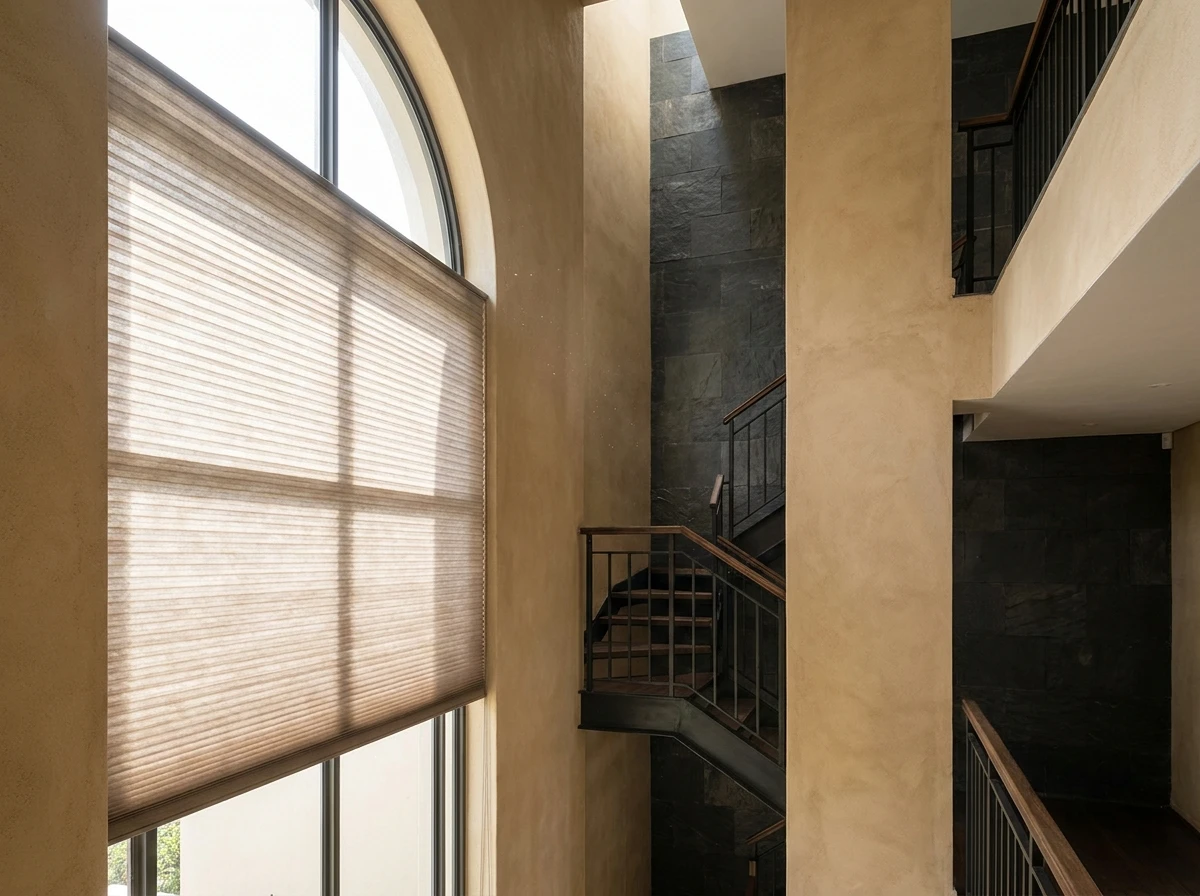
- Stairwells and double-volume glass — almost always the tallest windows in the house and almost always the ones nobody can reach. Motorise anything above the first landing and be done with it.
How the light comes down a stepped house
Almost nothing in Fresnaye is built on flat ground, so a house here is not one building with a sun problem. It is three or four half-levels stacked down a fall, each one holding its own strip of glass, and the light arrives at them in sequence rather than all together.
In the morning the shadow of the ridge retreats from the top down. The roof deck and the upper suite come out of shade first; the living floor a half-level below picks it up some minutes later; the pool terrace at the bottom of the steps is last, because it is furthest down the slope and has the most mountain to see over. On a winter morning you can stand on the stair and watch the line move.
That sequence matters for two reasons that end up on a quote:
- The levels do not want the same product. A pool terrace that only comes into sun at eleven and then bakes until dark has a completely different brief from a top-floor bedroom that catches an hour of gentle early light and then sits in its own eave shadow until three.
- The levels do not want the same control. Nobody is walking down two flights to pull a chain, and nobody wants a chain hanging beside a frameless corner window with a forty-metre drop beneath it. Levels you use daily can stay manual. Levels you visit — the guest floor, the gym, the top deck — are the ones where motorisation stops being a luxury and starts being the reason the blind gets used at all.
When a consultant comes out, we read each level as its own elevation and quote it separately. It is common for one house to leave with three different answers, and that is not upselling — it is the honest consequence of building on a hillside.
Two o'clock, and the whole west face at once
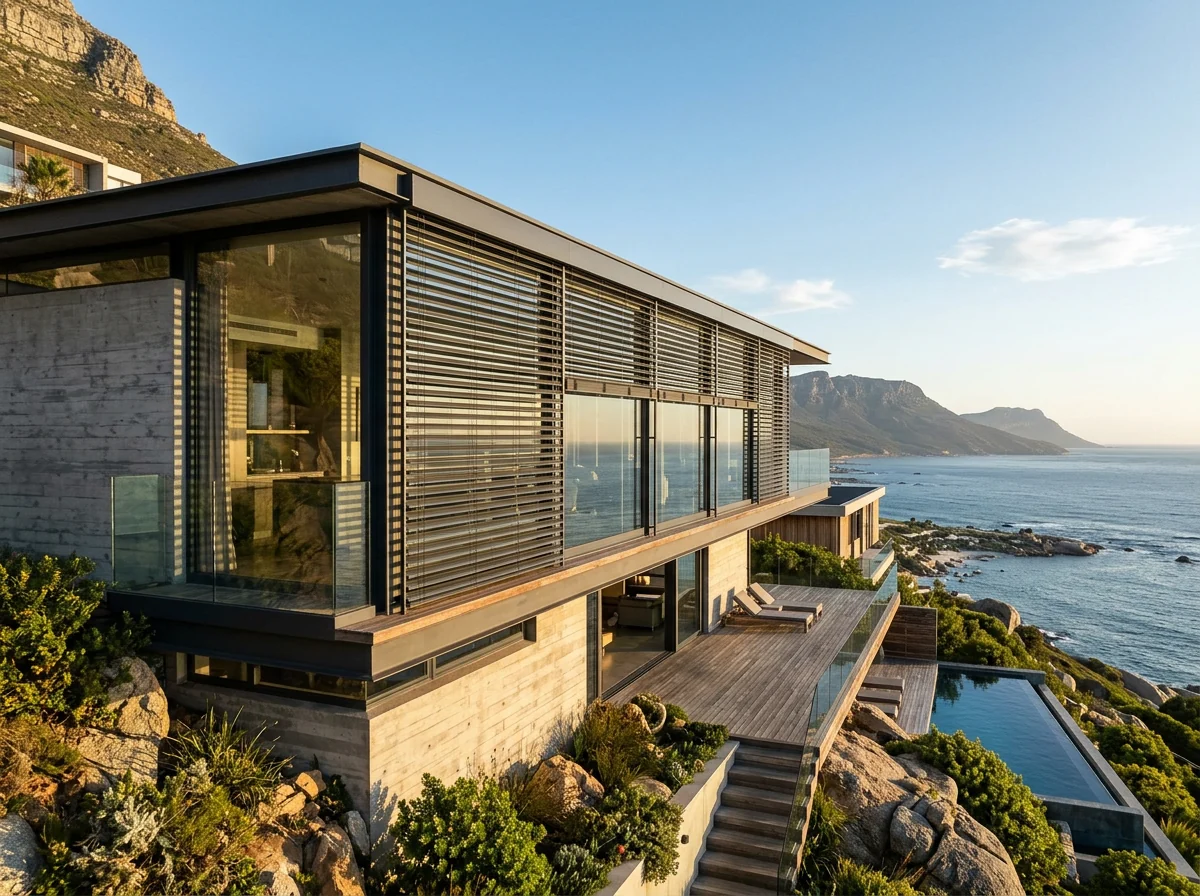
Everything the mountain took in the morning, the ocean gives back after lunch, and it gives it back with nothing in the way. There is no ridge, no neighbour and no tree between a Fresnaye west wall and the horizon — the next obstruction is the open Atlantic. So the afternoon does not creep up on you. It arrives on every square metre of west-facing glass in the house at more or less the same moment.
An internal blind, whatever it is made of, is on the wrong side of that. The sun has already come through the pane and become heat inside the room before the fabric gets a chance to do anything; the fabric then warms up and re-radiates a good part of it back at you. On a normal window that is a minor inefficiency. On a nine-metre glass wall facing an unshaded western horizon it is the whole ballgame.
This is why the premium answer here is external, and why we lead with it rather than tacking it on at the end of a quote.
External venetian blinds — wide aluminium slats hung outside the glass on their own guides. Tilt them and you cut the sun without cutting the view, which on this coast is the entire negotiation. They are the most capable thing we fit and they are not cheap; nothing else does both jobs as well.
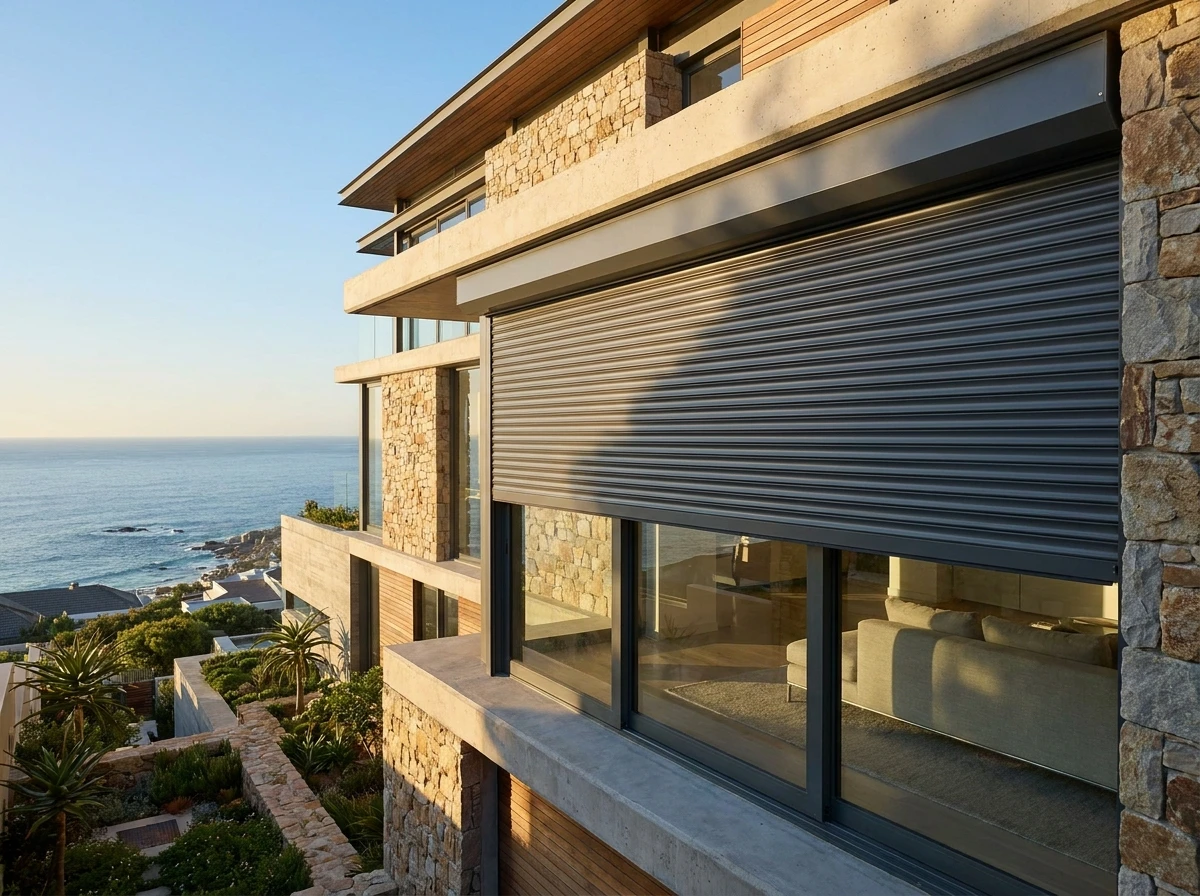
Roller shutters — rigid aluminium slats rolling down outside the pane from a headbox above it. Sun and glare control that goes from fully open to fully closed and stops anywhere in between, and the most robust thing we can hang on an exposed elevation.
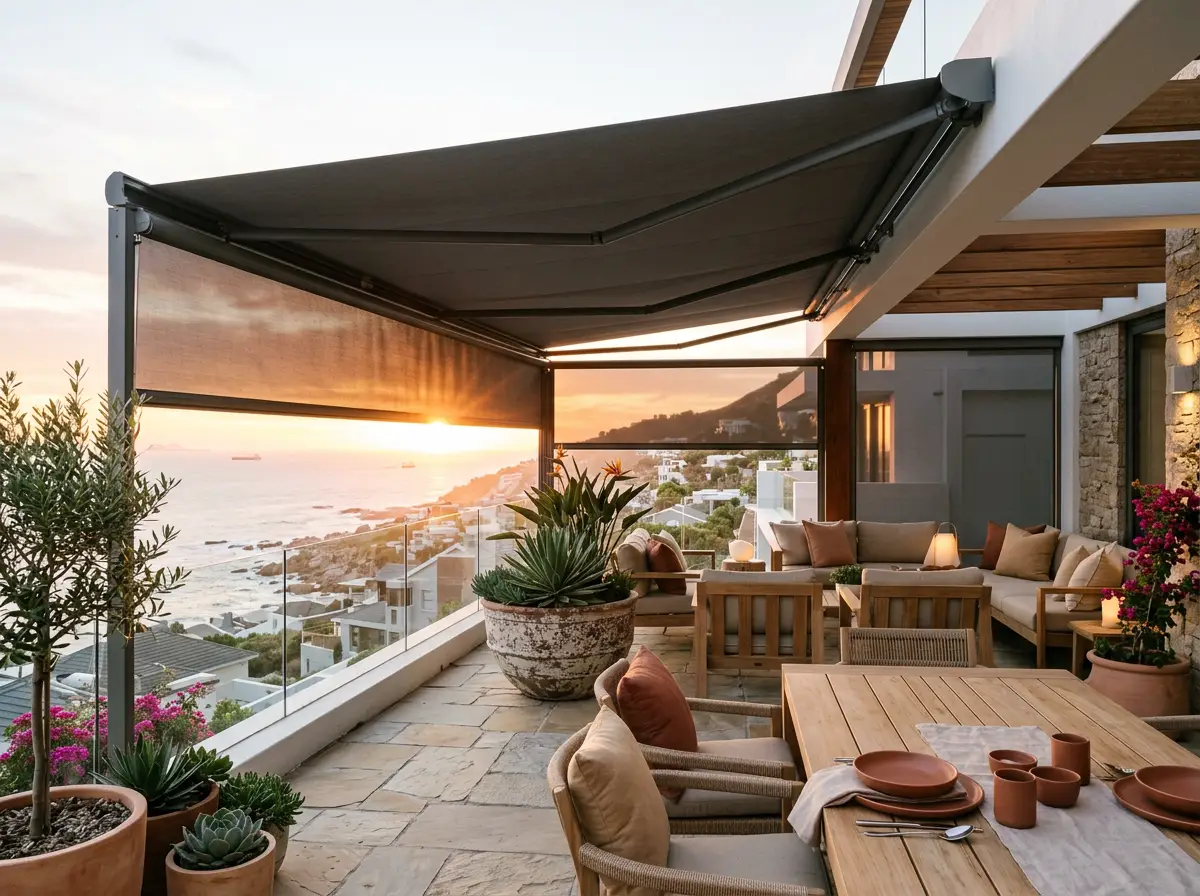
Zip screens — a tensioned mesh locked into aluminium side channels so it cannot lift or flap. Best where the opening is a terrace rather than a window: it takes the glare down and keeps the outlook, and it is the only exterior fabric we will hang on a genuinely windy corner.
The trade-off, stated honestly. Everything above lives outside in salt air. It costs more up front than an internal blind, it wants an occasional rinse with fresh water, and on a sectional-title or shared-facade building it needs permission before it goes up. What you get back is heat stopped before it becomes heat, and a view you keep all afternoon.
Inside, on the same elevation, the internal blind still has a job — night privacy, dark for sleeping, and softening the last of the glare after the exterior product has done the heavy lifting. It is just no longer being asked to solve a thermal problem it was never built for.
Why June is worse than December on this coast
People fit shading in January and are then surprised by July. The numbers explain it. At the December solstice the Cape Town midday sun stands around 75 degrees up — nearly overhead — and sets on a bearing near 240 degrees, well round to the south-west. At the June solstice midday tops out near 31 degrees, and the sun sets at around 297 degrees, out to the north-west.4
Two consequences, both of which land on Fresnaye specifically:
- Your eave stops working. A 75-degree summer sun is easy for any overhang to catch. A 31-degree winter sun walks straight underneath it, and by four in the afternoon it is lower still and effectively horizontal. The architectural overhang that keeps your December terrace comfortable does close to nothing for you in June.
- The sunset moves onto a different wall. A north-west facing room that is perfectly pleasant on a December evening — because the sun has swung round to the south-west — takes the full low blast of a June sunset straight through the glass. That is why winter, not summer, is the season we get called about most on this slope.
Add the water. A calm sea west of you is a very large mirror pointed at your windows, and it puts a second helping of low light up under any horizontal shade you own. Nothing fixes that from above; it has to be intercepted at the glass, or on the vertical, which is exactly what a drop screen or an exterior blind does and a fixed pergola does not.
The glass a house like this actually has
Fresnaye stock runs from small older cottages near the top of the avenues to recent architect-built villas with very little solid wall left in them. The recent ones tend to share a handful of openings that make life awkward for anyone measuring:
- Wide stack or slide-and-stack doors. Often four, six or eight metres across. Beyond about three metres a single blind wants a heavier tube to stop the fabric bowing in the middle, or the run gets split into two or three blinds coupled to one motor so they move as one.
- Frameless corner glazing. Two panes meeting at a corner with no mullion. There is nothing to fix a bracket to at the junction, so the head fixing goes to the ceiling or a recessed channel — which needs deciding before the ceiling is closed, if you are still building.
- Tall stairwell and double-volume glass. Beautiful, and unreachable. This is the classic case for a rechargeable tube motor, because it needs no wiring at all and can go into a finished house without opening a wall.
- Deep terrace openings with no head. Where a terrace has a slab above it but no wall behind, the fixing has to come off the soffit — a folding-arm awning or a drop screen off the slab edge, rather than anything mounted at a window that does not exist.
Older properties on this slope bring a different question. Under the National Heritage Resources Act, any structure or part of a structure older than sixty years needs a permit from the provincial heritage authority before it is altered.5 That is a national rule, not a local by-law, and it can apply to a modest cottage as readily as to a landmark. If your house is old enough for it to be live, the safe route is anything reversible and internally fixed, and a call to Heritage Western Cape before anything is drilled into an original facade. We will tell you when we think you are in that territory; we will not pretend to give you the ruling.
Your top terrace and your bottom terrace are in different weather
The south-easter — the Cape Doctor — runs hardest through the summer months and is at its strongest in the afternoon.6 On a flat suburb that is a single fact about the whole property. On a stepped Fresnaye stand it is not, and the difference is bigger than people expect.
An upper deck with an open sky behind it takes the gusts unbroken. Two levels down, tucked behind the mass of the house and the retaining walls, a pool terrace can be almost still on the same afternoon while the roof deck is unusable. We have specified two quite different products on one property for exactly that reason, and it was the right call both times.
So the rule for anything we hang outside is not "wind-rated everywhere". It is:
- Guided, not loose. Exposed openings get fabric locked into side channels, so there is nothing for a gust to get under. A free-hanging outdoor blind on a top deck here has a short life.
- Sensored, where it retracts. Anything that folds or rolls away — an awning, an exterior roller — is worth a wind sensor that pulls it in before the gust rather than after the repair.
- Sheltered levels can relax. If the bottom terrace genuinely sits in the lee, we will say so and quote something simpler for it instead of charging you for hardware the wind will never test.
Salt is the other constant, and it is not solved by a bracket choice alone. Marine and coastal atmospheres sit in the highest corrosivity categories in the international classification for exactly this reason.7 We specify powder-coated aluminium and sealed housings on everything mounted outside, and we say honestly that a fresh-water rinse a few times a year is part of owning exterior shading this close to the water. Anyone telling you their outdoor hardware is maintenance-free on the Atlantic Seaboard is telling you something else too.
What we still can't tell from a photograph
Everything above can be worked out from a map and an almanac. These cannot, and they are usually the things that decide the specification:
- What your neighbour's building does to your sun. On stands this tight and this steep, the house above you may already be shading your top floor at four o'clock, or the white wall opposite may be bouncing light back into a room that faces away from the sun entirely.
- Whether the reveals are square. Older Fresnaye houses frequently are not, and a made-to-measure blind ordered off a square assumption arrives with a light gap down one side.
- Where the power is. Wired motors are the better long-term answer where power can reach the head of the opening. In a finished house it often cannot, and then rechargeable is the sensible call. That is a five-minute check on site and a guess from a distance.
- What the room is actually for. A study that needs no screen glare, a nursery that needs no cords within reach, a dining terrace only used after six — these change the answer more than the compass does.
- Which hour genuinely ruins the room. Not "the afternoon". The hour. Tell us that and half the specification writes itself.
The measure is free, it carries no obligation, and the consultant arrives with samples so you can hold a fabric up against your own glass at the hour that is bothering you. Nothing here is priced from a catalogue, because everything is cut to your openings — the written quote comes back itemised per window so you can see each one and remove any of them.
Your free measure
Tell us which hour ruins the room
Send this through and one of our expert consultants will contact you shortly to arrange a free in-home measure, with samples, at a time when the sun on that elevation is doing whatever it is you want stopped.
Thank you — that is through.
One of our expert consultants will contact you shortly to arrange your free in-home measure, with samples, at a time that suits you.
Your details are used only to arrange your consultation call-back and quote. We never sell or share them, and we do not add you to a marketing list (POPIA).
Sources
What we checked, and where
Every height, bearing and legal rule above comes from one of the seven references below, and you are welcome to check any of them. The skyline sum in section one is arithmetic we did ourselves off published heights, and it says so where it appears. What we suggest fitting is a judgement call on our side, not a research finding.
- Wikipedia — Atlantic Seaboard, Cape Town (the coastal strip running from the City Bowl side of Signal Hill down past Sea Point, Bantry Bay, Fresnaye, Clifton and Camps Bay, on the seaward slopes below Lion's Head).
- Wikipedia — Lion's Head, Cape Town (summit height of 669 m, the figure used in our skyline working).
- Wikipedia — Signal Hill, Cape Town (height of about 350 m, the lower ridge north of Lion's Head).
- Gaisma — Cape Town sun and moon data (solstice elevations at 12:00 of roughly 31° in June and 75° in December; sunrise bearings near 62° and 118°; sunset bearings near 297° and 240°). This page states the sun's actual peak, calculated from the latitude with a ±23.44° declination; the numbers above are the source's 12:00 readings.
- SAFLII — National Heritage Resources Act 25 of 1999. Section 34 makes it an offence to change or pull down a building over 60 years old, or any piece of one, without first obtaining a permit from the relevant provincial heritage resources authority.
- Wikipedia — Cape Doctor (the persistent, often strong south-easterly wind of the Cape Peninsula's summer months).
- ISO — ISO 9223:2012, Corrosivity of atmospheres (the classification scheme that places marine and coastal atmospheres in the higher corrosivity categories).
Everything on this page is our own reading of the suburb, offered free and with nothing to sign. It is not a heritage ruling, not a structural opinion and not a compliance certificate. For a ruling on an old facade you need the provincial heritage authority; for anything load-bearing you need a registered professional; for zoning you need the municipality. We will tell you when you have reached one of those doors.